
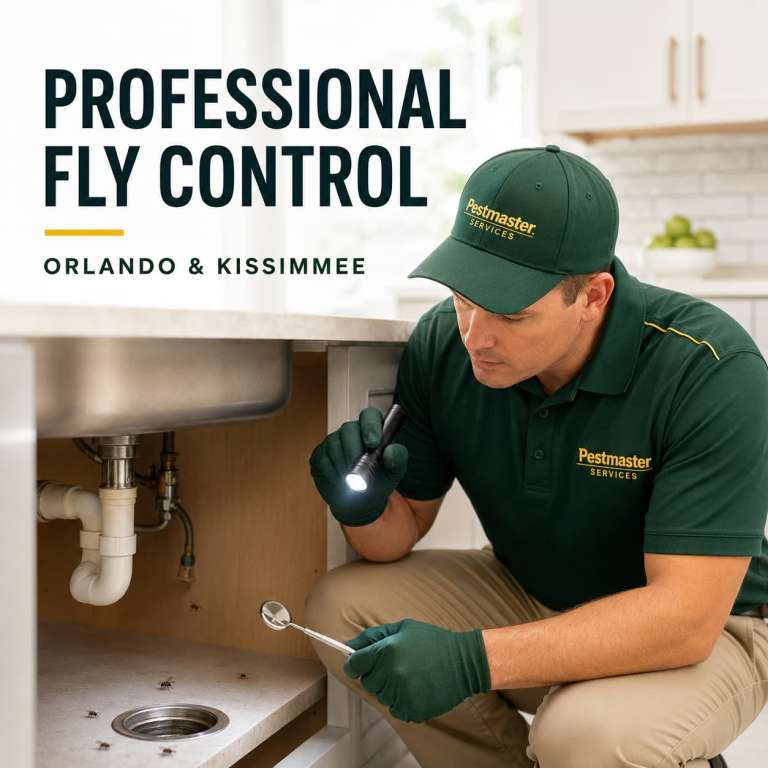
Professional Fly Control in Orlando & Kissimmee

Flies in your home, restaurant, or business? We identify the species, locate breeding sources, and develop a targeted plan to reduce activity.

We treat house flies, fruit flies, drain flies, and phorid flies.

★ Excellent Google Reviews

Professional Fly Control. Clear Recommendations.

Flies can continue breeding when moisture, organic residue, waste, or entry points remain. Our licensed team inspects the conditions supporting the activity and recommends the appropriate service for your property.

  • BBB A+ Rating
  • FDACS Licensed
  • Ph.D. Entomologist-Supervised
  • 10+ Years in Central Florida

Free Estimate · No Long-Term Contracts · Service in English and Spanish

Clear Residential Pricing

Choose the Right Fly Control Option

Select ongoing monthly protection or schedule a one-time service for a current fly problem.

Best for Recurring Activity

Monthly Fly Protection

Ongoing service for properties experiencing recurring fly activity.

$145 initial service

$39 / month

Scheduled service every month

  • Initial inspection and targeted first service
  • One scheduled fly-control visit every month
  • Monitoring of active and high-risk areas
  • Source-control and prevention recommendations
  • Re-treatment coverage while the plan remains active
Re-Treatment Guarantee If covered fly activity returns between scheduled services, we will evaluate the affected area and provide the re-treatment included with your active plan, subject to the service terms.
Start Monthly Protection
One-Time Fly Service

A focused service for a current or recently discovered fly problem.

$195

One-time residential service

  • Inspection of the affected areas
  • Evaluation of likely fly sources
  • Targeted one-time treatment
  • Practical prevention recommendations
  • Optional follow-up when additional treatment is needed
Schedule One-Time Service

Residential pricing applies to qualifying properties and covered services. Sanitation, moisture, plumbing, waste, or structural conditions may require correction by the customer. Re-treatment applies while the monthly plan remains active.

Ready to Address the Problem?

Get the Right Fly-Control Plan for Your Property

Tell us where you are seeing fly activity. We will review the situation and recommend a one-time service, monthly residential protection or a customized commercial plan.

Residential and commercial service · English and Spanish · Clear written service terms

Why Fly Activity Returns

If Flies Keep Returning, Something Is Supporting Them

Treating only the adult flies may reduce what you see temporarily. Recurring activity often indicates that food residue, moisture, organic buildup, waste, or an exterior entry route remains.

The Visible Flies Are a Clue

Where and when flies appear can help narrow down the likely source. Activity around kitchens, windows, restrooms, waste areas, or entrances may point to different conditions.

Breeding Conditions Can Be Hidden

Drains, wet organic residue, spills beneath equipment, recycling areas, waste containers, and decaying material can support continued activity even when surfaces look clean.

The Species Changes the Plan

House flies, fruit flies, drain flies, and phorid flies do not develop in the same places. Proper identification helps direct the inspection and determine the appropriate response.

Common Fly Problems

Different Fly Species Need Different Solutions

Similar-looking flies can develop in very different materials and locations. Our inspection looks beyond the visible adults to evaluate the conditions that may be supporting continued activity.

House Flies

House flies may develop around moist garbage, animal waste, discarded produce and other decomposing organic material.

Common clues Medium-sized gray flies around trash areas, doors, windows, kitchens or food-handling spaces.

Fruit & Vinegar Flies

These small flies are commonly associated with fermenting produce, beverage residue, recycling containers and food waste.

Common clues Tiny flies gathering around fruit, beverage stations, trash cans, bars or food-preparation areas.

Drain & Moth Flies

Drain flies may develop in moist organic buildup inside plumbing or in areas affected by persistent drainage or moisture problems.

Common clues Small, fuzzy, moth-like flies resting near sinks, floor drains, showers or other continuously damp areas.

Phorid Flies

Phorid flies can develop in moist, decaying organic material associated with drains, waste areas and plumbing or sewer leaks.

Common clues Very small flies with a humpbacked profile that may run erratically across surfaces more often than they fly.

Blow & Bottle Flies

These larger metallic flies are often associated with animal remains, pet waste or other decomposing organic material.

Common clues A sudden appearance of multiple large metallic flies indoors may indicate a concealed source that requires investigation.

Our Process

How Professional Fly Control Works

Effective service requires more than treating the flies currently visible. We evaluate where activity is occurring, what may be supporting it and which corrective measures are appropriate for the property.

  1. Inspect Activity Areas

    We examine the rooms, surfaces, drains, waste areas and exterior zones where flies have been observed or are most likely to gather.

  2. Trace Contributing Conditions

    We look for moisture, organic residue, waste, damaged screens, entry points and accessible areas that may allow continued fly activity.

  3. Apply Targeted Control

    The service method is selected according to the fly involved, the affected location, property use and conditions observed during the inspection.

  4. Document and Reassess

    We document findings, explain recommended corrections and evaluate progress during follow-up service when it is included or requested.

Helpful Answers

Frequently Asked Questions About Fly Control

Clear answers about recurring activity, drains, traps, commercial service and what to expect after treatment.

Why do flies return after the visible adults are treated?

Treating adult flies can reduce immediate activity, but eggs, larvae or supporting material may remain in another location. Moist organic residue, waste, fermenting material, animal remains, plumbing problems and exterior entry points can continue producing or attracting flies until the contributing condition is corrected.

How can I tell if flies are developing inside a drain?

Small flies repeatedly resting near sinks, floor drains, showers or other damp plumbing areas can indicate activity connected to a drain. However, location alone does not confirm the source. Organic buildup, hidden moisture, leaking pipes and nearby waste areas should also be evaluated.

Are fly traps enough to solve an infestation?

Traps can reduce adult flies and help monitor where activity is concentrated, but they usually do not remove the material where immature flies are developing. Effective control may require a combination of treatment, sanitation, moisture correction, exclusion and removal of the supporting source.

Does fly-control service include drain cleaning or plumbing repairs?

Pest-control service addresses covered fly activity and provides recommendations based on the conditions observed. Mechanical drain cleaning, sewer work, plumbing repairs, structural corrections or removal of inaccessible organic material may require action by the property owner or another qualified service provider.

Do you provide fly control for restaurants and commercial kitchens?

Yes. Commercial plans are available for restaurants, kitchens, food-service areas and other businesses. The recommended scope and frequency depend on the facility, operating conditions, sanitation practices, waste handling and level of fly activity.

What should I expect after fly treatment?

Existing adult flies or adults emerging from previously developed immature stages may remain temporarily after service. Following the sanitation, moisture-control, waste-management and repair recommendations provided for the property helps reduce the chance of continued activity. Follow-up service depends on the plan selected and its written conditions.

Guided by a Ph.D. Entomologist

Service recommendations are based on pest biology, site conditions, and Integrated Pest Management principles.

Integrated Pest Management (IPM) Experts

Integrated Pest Management using EPA-registered products according to label directions when pesticides are needed.

fly inspection

Fully Insured & FDACS Licensed

Florida Pest Control License JB274674, backed by $2M in liability coverage.

Active City of Orlando Contractor

Selected to help protect 140+ municipal facilities—the same professional standards we bring to residential service.

Control Service Areas Across Central Florida

Osceola County

Kissimmee, Poinciana, St. Cloud, Fuller Heights, Buenaventura Lakes.

Seminole County

Sanford, Oviedo, Altamonte Springs, Casselberry, Winter Springs.

Orange County

Orlando, Apopka, Ocoee, Winter Garden, and Winter Park, Lake Butler.

Polk County

Lakeland, Davenport, Winter Haven, Haines City, Bartow, Waverly, Homeland.

Hillsborough County

Plant City, Tampa, Brandon, Dover, Riverview.

to top