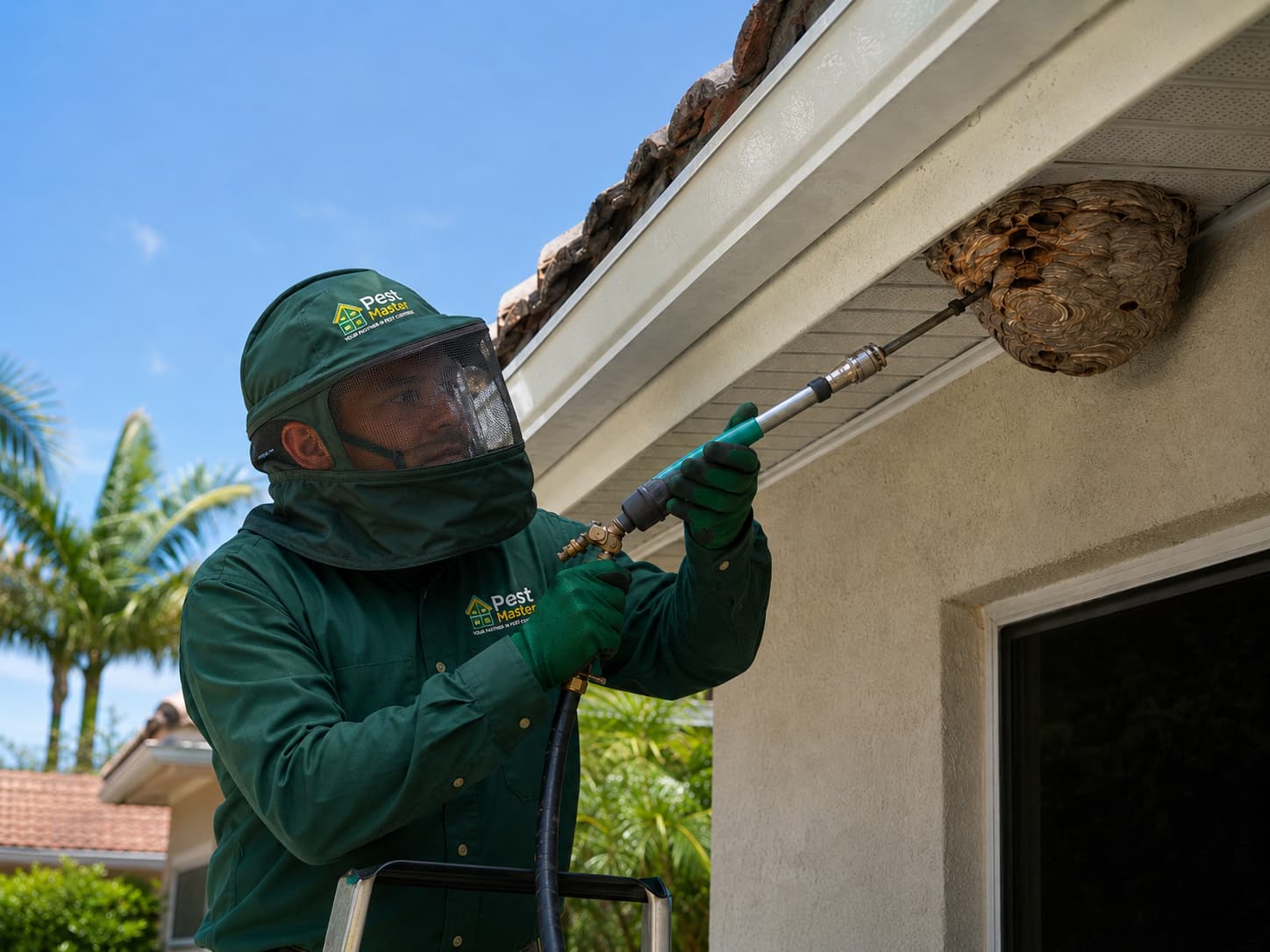
Emergency Wasp and Hornet Nest Removal in Orlando and Kissimmee

Protect your home and family with same-day service. FDACS-licensed technicians. Fast, Targeted Wasp & Hornet Control

Dont Wait!  An active nest can quickly become a safety concern. Our professional wasp removal service locates the nest, treats the source of the activity, and helps you regain peace of mind.

Pet Friendly · Licensed · Insured · Local

Professional Wasp Nest Service You Can Trust

We inspect the activity, locate the nest or entry area when possible, explain the recommended service and provide clear pricing before work begins.

BBB A+ FDACS Licensed Fully Insured Ph.D.-Guided Protocols

Free estimate · Residential and commercial · English and Spanish · Same-day appointments may be available

Wasp Nest Service for Homes and Businesses

An Active Wasp Nest Near a Doorway, Patio or Roofline Should Not Be Ignored

Wasps often build nests in protected areas around a property, including eaves, shrubs, rooflines, wall openings and trees. When activity is close to entrances, walkways or areas used by customers, children or pets, the risk of painful stings can increase.

Pestmaster evaluates where the activity is coming from, determines whether the nest is visible or concealed and recommends the appropriate service before work begins.

We focus on the source of the activity—not only the wasps you see flying.Locating the nest or primary entry area helps us select a more precise treatment for the conditions found at your property.
Pestmaster technician inspecting a wasp nest on a residential property
FDACS Licensed
Residential & Commercial
Same-Day Appointments May Be Available
English & Spanish Service
What Your Service May Include

A Clear Plan Based on the Nest Location and Level of Activity

The recommended service depends on the species, accessibility, height, nesting area and whether the activity is exposed or inside a structure.

1

Activity Assessment

We inspect the area, observe flight patterns and identify the likely source of the activity.

2

Nest or Entry-Point Evaluation

We determine whether the nest is visible, concealed, underground or associated with an opening in the structure.

3

Targeted Treatment

We apply treatment to the appropriate area and explain what activity may be expected afterward.

4

Nest Management & Recommendations

When appropriate and accessible, we evaluate physical removal and provide practical recommendations for the property.

Clear pricing before service.Cost may vary based on height, accessibility, nest location, species and the treatment required. We explain the recommended work and price before you authorize the service.
Why the Nest Location Matters

Visible Nests and Concealed Activity Require Different Responses

An exposed paper nest under an eave is different from repeated activity entering a wall void, underground nest or roof opening. Our goal is to recommend the service that fits the actual conditions rather than use the same approach for every property.

Exposed Nest

The nest can be seen and its location and accessibility can be evaluated directly.

Concealed Nest

Repeated traffic may indicate activity inside a wall, soffit, roofline or another protected cavity.

Ground Activity

Yellowjackets and certain solitary wasps may nest in soil or landscape areas and require a different assessment.

Found an Active Nest Near Your Home or Business?

Keep people and pets away from the area and contact Pestmaster for an inspection, treatment recommendation and clear estimate.

Wasp & Hornet Guide

Identification, Nesting Behavior and Safety Information

The guide below explains common stinging insects found in Florida, where they may establish nests, how their behavior differs and what property owners should know before approaching an active colony.

Identification matters because social species may strongly defend the nest, while many solitary species are less defensive and require a different response.
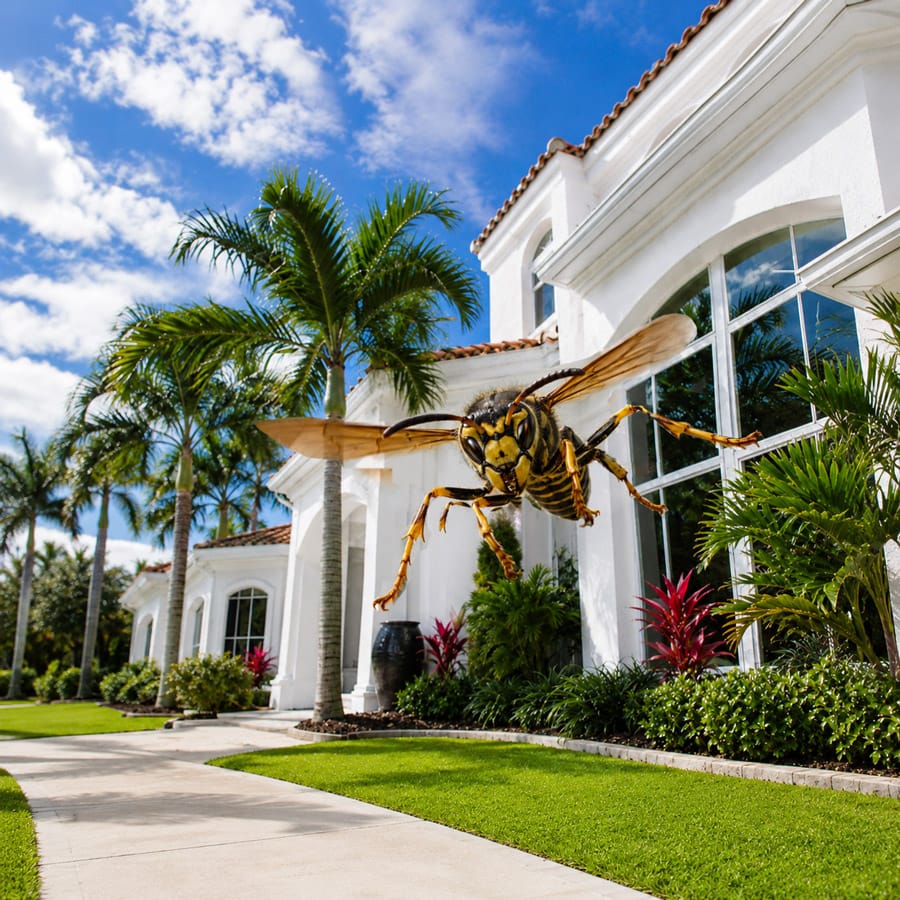
Wasps flying near the exterior of a residential property
Common Florida Species

Wasps and Hornets Commonly Found Around Florida Properties

Photos make this section easier to scan and help visitors compare visible features, nest structure and behavior. A field inspection may still be needed when insects or nests cannot be viewed clearly.

Paper wasps on an open paper comb nest

Paper Wasps

Identification: Slender wasps that commonly build open, paper-like comb nests under eaves, ledges and other protected surfaces.

Behavior: Social insects that may defend the nest when disturbed.

Yellowjacket with yellow and black body markings

Yellowjackets

Identification: Compact yellow-and-black wasps. Nests may be underground or inside concealed spaces above ground.

Behavior: Social and potentially highly defensive near the colony.

Bald-faced hornet with black body and white markings

Bald-Faced Hornets

Identification: Predominantly black wasps with white facial and body markings. They build large enclosed paper nests above ground.

Behavior: Can strongly defend the area around an active nest.

Mud dauber wasp with a narrow waist and dark body

Mud Daubers

Identification: Slender solitary wasps that build mud or clay nests under eaves, porch roofs and inside garages or sheds.

Behavior: Generally less aggressive and unlikely to sting unless handled or trapped.

Eastern cicada killer wasps showing their large body size

Cicada Killers

Identification: Large ground-nesting solitary wasps with dark bodies and yellow markings.

Behavior: Their size can be intimidating, but they are usually less defensive than social nesting species.

Where Nests May Be Found

Common Nesting Areas Around Homes and Businesses

Rooflines and Eaves

Paper wasps and mud daubers commonly use protected ledges, soffits, porch roofs and overhangs.

Walls and Structural Openings

Repeated traffic through one opening can indicate a concealed colony inside a wall, soffit or roof cavity.

Trees and Shrubs

Enclosed paper nests may be suspended from branches or hidden inside dense vegetation.

Soil and Landscape Areas

Yellowjackets and some solitary species may nest underground, near roots, turf or disturbed soil.

Garages, Sheds and Equipment

Protected structures, stored items and infrequently disturbed spaces can provide suitable nesting locations.

Mailboxes and Utility Areas

Small protected cavities may attract solitary species or serve as temporary nesting sites.

Around an Active Nest

What to Do—and What to Avoid

Some species can react defensively when the nest is disturbed. The safest first step is to keep people and pets away from the activity area.

Recommended

  • Keep a reasonable distance from the nest.
  • Keep children, customers and pets away from the area.
  • Observe repeated traffic only from a protected location.
  • Note the opening or structure where insects are entering.
  • Contact a professional when activity is near occupied spaces.

Avoid

  • Do not strike, shake or disturb the nest.
  • Do not spray the nest with water.
  • Do not attempt to burn or knock down an active nest.
  • Do not immediately seal an active structural opening.
  • Do not approach a concealed colony without understanding the risk.

Emergency: Severe Reaction After a Sting

A severe allergic reaction can be life-threatening. If someone develops difficulty breathing, severe swelling, loss of consciousness or other serious symptoms, call 911 immediately.

Multiple stings may also require urgent medical evaluation. Florida Poison Control can provide guidance for bites and stings at 1-800-222-1222.

Frequently Asked Questions

Wasp Nest Treatment, Activity and Prevention

Do wasps reuse the same nest?

Many social wasp colonies do not reuse an old nest the following season, although protected areas around the property may attract new nesting activity.

Why are wasps suddenly appearing around one area?

Repeated traffic may indicate a nearby nest, food source, water source or opening that leads into a concealed space.

How long can activity continue after treatment?

The timeline depends on the species, nest location, treatment method and accessibility. Some activity may continue temporarily while remaining insects return to or leave the treated area.

Should an empty nest be removed?

Removal may be appropriate when the nest is accessible and creates a nuisance or concern. It is not always necessary, and the technician can explain the options based on the location.

Can wasps nest inside walls?

Yes. Repeated activity entering one opening near siding, soffits, utility penetrations or rooflines may indicate a concealed nest.

Why should an active entry point not be sealed immediately?

Sealing the opening before the activity is properly addressed may cause insects to search for another route, including into occupied areas.

What affects the cost of wasp nest service?

Price may depend on height, accessibility, nest location, species, whether the nest is exposed or concealed and the treatment required.

Identification image credits: Paper wasps—Dicklyon, CC BY-SA 4.0; Yellowjacket—Bombman356, CC BY-SA 3.0; Bald-faced hornet—Judy Gallagher, CC BY 2.0; Mud dauber—Wikimedia Commons contributor, CC BY 2.0; Cicada killer—Chuck Holliday, public-domain/no known copyright restriction. Images are loaded from Wikimedia Commons and may be replaced with Pestmaster-owned photographs after uploading them to the Media Library.

Need Help Identifying or Treating Wasp Activity?

Pestmaster serves homes and businesses in Orlando, Kissimmee and selected communities throughout Central Florida.
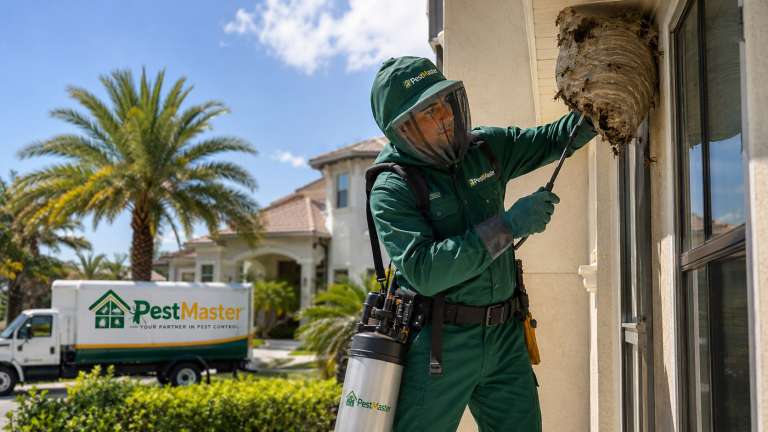

Active City of Orlando Contractor

 Selected to protect 140+ Municipal facilities — the same professional standard now protects your home.

Locally owned and backed by more than 10 years.

A wasp or hornet nest can pose an immediate threat. Disturbing it may trigger aggressive stinging and endanger your family, pets, and guests.

Wasps & Hornets Pest Control FAQs

Yes. We use EPA-registered products and apply them according to label directions. Once treated areas are fully dry—typically within about 10 minutes—they are safe for children and pets to re-enter. Our FDACS-licensed technicians follow strict application protocols to protect your family throughout the service.

Most residential treatments are completed in 20–60 minutes. Commercial properties may require additional time depending on size and severity. You will receive a detailed service report immediately after every visit.

Most homes should be inspected for wasp and hornet activity on a regular basis, especially during the warmer months when nests are more likely to develop. In Central Florida, we recommend treating active nests as soon as they are found and including wasp and hornet prevention as part of a routine pest control program.
The exact treatment frequency depends on the property, the level of activity, nearby trees or landscaping, rooflines, eaves, sheds, and other nesting areas. Our technicians inspect these high-risk areas during service visits and provide targeted treatment when needed to help keep your home and outdoor spaces protected.

Our process starts with species identification — because different stinging insects require different treatment approaches. Our fully protected FDACS-licensed technicians approach the nest during optimal conditions (typically early morning or evening when wasps are least active), apply professional-grade contact and residual insecticides directly to the nest, allow sufficient time for the product to eliminate the colony, and then physically remove the nest structure to prevent re-colonization. A preventive deterrent is applied to the location to discourage future nesting. Every treatment is performed with full professional-grade PPE for maximum technician and client safety.

The cost of wasp and hornet removal depends on the number of active nests, the height and accessibility of the treatment areas. Prices start at $195, and the final cost is confirmed after a brief assessment.

Your estimate is always free. Call us today at (407) 818-5872 to schedule fast, local service.

For most treatments, we recommend that you and your family stay indoors and keep windows and doors closed during the treatment. Your technician will advise you on the specific re-entry time for your treatment — typically 1–2 hours. For large or aggressive colonies such as yellow jackets, we may recommend temporarily vacating the immediate area during treatment.

Yes. We are a fully bilingual company and provide service, communication, and reporting in both English and Spanish.

Yes. Our programs focus on building a protective barrier around your home’s exterior — treating entry points, the foundation, eaves, and the yard perimeter — to stop pests before they get inside.

Do not disturb the nest under any circumstances. Keep children and pets away from the area. Do not spray the nest with water, insecticide, or any other substance — this will agitate the colony and trigger an aggressive defensive response. Mark the location if possible and keep a safe distance until our technician arrives. If anyone is stung multiple times or shows signs of an allergic reaction, call 911 immediately.

We offer same-day and emergency wasp removal service across Central Florida. A wasp or hornet nest is a genuine safety emergency — especially for households with children, pets, or individuals with known allergies. Call us at (407) 818-5872 for immediate response. In most areas we can deploy a technician the same day.

home protected from Wasp & Hornet in Orlando & Kissimmee

Integrated Pest Management built for your home

Avispas agresivas cerca de tu casa

Protect your home & family from aggressive wasps and hornets

to top
Call Us Now WhatsApp Text Us